

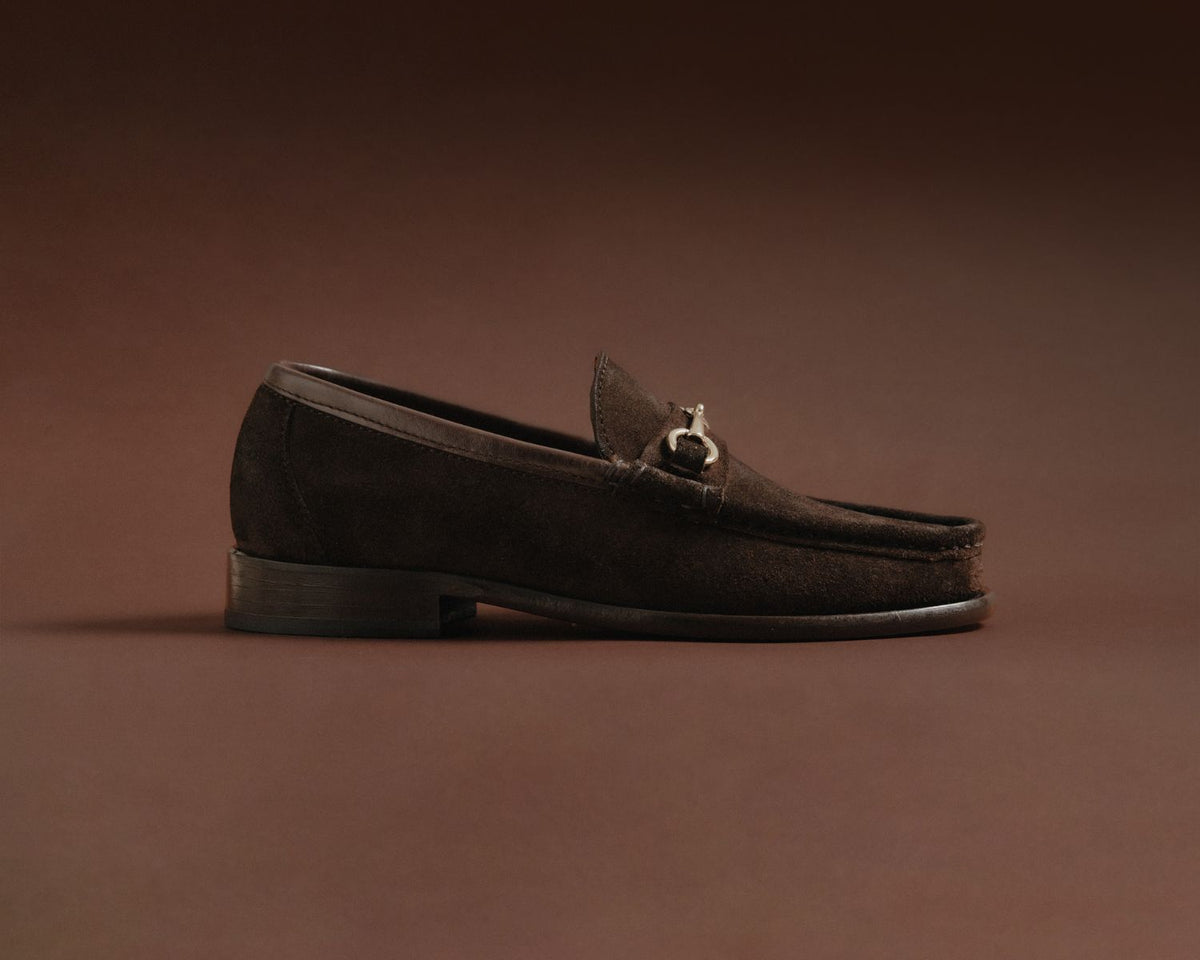

Silent footwear mistakes that ruin a good outfit
In dressing, the most damaging mistakes are rarely flashy. They don't manifest as obvious breaches, but as small dissonances that alter the harmony of the ensemble. Footwear occupies a particularly delicate place within that balance: it is the point of contact with the environment, the visual conclusion of the silhouette, and one of the elements that most quickly reveals inconsistencies.
One of the most common errors stems from an imprecise perception of formality. Not every leather shoe is automatically elegant, nor is every sober design suitable for a suit. Confusion often arises with hybrid models, with constructions or details that place them in an ambiguous category.
A shoe with open lacing—typical of Blücher-type constructions—may be impeccable in terms of quality, but convey a lower degree of formality than a strictly formal outfit requires, for which an Oxford would be more suitable. The difference between a closed and open lacing system is not decorative; it affects the visual tension of the instep, the cleanliness of the lines, and the social reading of the shoe.
Disproportion is another silent error that operates with great destructive efficiency. The relationship between the last, the toe, the volume of the sole, and the drape of the trousers constitutes an interdependent system. An excessively thick sole alters the visual center of gravity of the ensemble and breaks the continuity between the bottom of the trousers and the shoe. Likewise, an exaggeratedly long or pointed toe introduces an artificial emphasis that unbalances the silhouette. The classic shoe demands a balance that, today, is difficult to find.
The condition of the leather communicates even before the design. Poorly hydrated leather loses elasticity, generates rigid micro-creases, and acquires a dull or cracked appearance. At the opposite extreme, the artificial shine produced by unsuitable silicones or waxes creates an unnatural reflective surface, lacking depth. Quality leather develops a progressive patina, a contained shine that arises from constant care and not from aggressive cosmetic solutions. When the finish looks plastic or excessively mirrored, the eye perceives the anomaly even if it cannot identify its technical cause.
The structure of the shoe can also deteriorate without dramatic signs. Irregular heel wear modifies the support angle and alters the biomechanics of the stride. A worn-out sole compromises stability and affects overall posture. Fatigued seams, incipient separations between sole and welt, or deformations in the back counter are not always visible from a distance, but they do influence how the wearer moves. Elegance is not just aesthetic appearance; it is the behavior of the ensemble in motion.
Decorative excess constitutes another common source of aesthetic friction. Unnecessary perforations, forced contrasts, or textures incompatible with the formality of the ensemble turn the shoe into a focal point that competes with the rest of the clothing. Classic footwear does not seek prominence, but integration. Its function is to support the coherence of the ensemble, not to demand it.
Finally, context acts as a regulatory framework that many neglect. A technically correct shoe may be inappropriate if it does not fit the environment, the moment, or the implicit code of the situation. The choice of footwear is not governed solely by personal preferences, but by the interaction between climate, surface, formality, and social function.
The sum of these errors does not usually cause immediate rejection, but it does erode the perception of solidity, judgment, and attention to detail. Coherence is not built through spectacular gestures, but through a chain of silent decisions. The shoe, though discreet, is one of the most important links.